How to participate in a cat show?
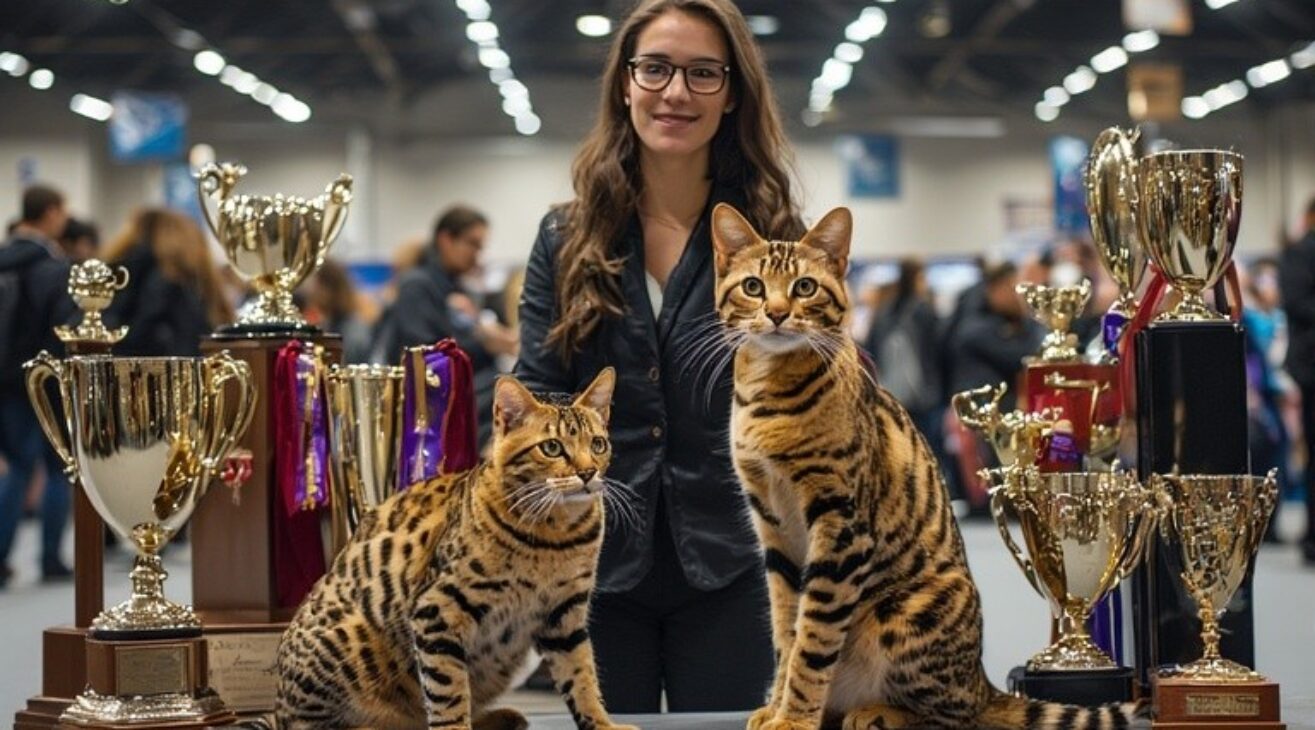
A cat show is a great opportunity to showcase the quality of your purebred cat, meet other breeders and cat lovers, and receive professional feedback on your cat’s appearance and temperament.
It’s also a place where breeders and owners can share experiences, compare breeding results, and see how their cats measure up to international breed standards.
Registration and preparation of documents
Registration for a show typically begins on the website of the relevant breed association or cat club, where you must fill out an application form and submit the required documents.
In all systems—whether it’s the WCF (World Cat Federation), TICA (The International Cat Association), or FIFe (Fédération Internationale Féline)—the following documents are required:
- A pedigree certificate or registration certificate confirming the cat’s origin and purebred status.
- Vaccination passport indicating valid rabies and feline viral disease vaccinations.
- Microchip data proving the identity of the animal.
- In some cases, the results of genetic tests, if they are necessary for participation in breeding classes.
The registration deadline is usually 2–4 weeks before the show. A veterinarian will check the health of each cat and the validity of their vaccinations on site.
Requirements for participating in the cat show
In order to be admitted to the exhibition, cats must meet certain requirements in terms of health, appearance, and behavior.
The cat must be:
- Healthy and vaccinated – a veterinary check-up is mandatory.
- Socialized and calm – there are lots of people, voices, and other animals at the show. The cat must be able to tolerate attention and unfamiliar surroundings.
- Compliant with the breed standard – the judge evaluates the body structure, coat, eye shape, color, character, and overall impression.
Exhibitions of different systems: WCF, TICA, and FIFe
Although the overall purpose of the shows is the same, the judging systems and titles vary significantly depending on which international organization the cat is registered with.
The most common systems in Estonia and Europe are the WCF (World Cat Federation), TICA (The International Cat Association), and FIFe (Fédération Internationale Féline).
WCF – World Cat Federation
Origin: founded in Germany, brings together over 500 cat clubs from around the world, including several clubs operating in Estonia (e.g., Cato, Fennica Cattus, Baltic Cat, Selena Tiger).
Exhibition structure:
- The shows usually last two days, and cats are divided into classes according to age, sex, breed, and coat type.
- Each cat participates in a class according to its title (e.g., Champion Class, Grand Champion Class, etc.).
- The evaluation is based on the breed standard, where the judge assesses the body structure, coat, color, head, and character.
Titles and point system:
- Titles are awarded step by step: Champion (CH), International Champion (ICH), Grand International Champion (GICH), etc.
- To get each title, you need a certain number of certificates (CAC, CACIB, CAGCIB) from different judges and shows.
- In addition, Best in Show, Best of Breed, and Best of Best categories will also be judged.
Characteristic:
- WCF exhibitions generally have a friendly and international atmosphere.
The opportunity to win several titles at once, as sometimes several parallel shows take place on the same weekend (multi-show format).
TICA – The International Cat Association
Origin: An American system that emphasizes openness and a dynamic judging system.
TICA shows are represented in Estonia by the Esticat club.
Exhibition format:
- TICA uses a ring system (rings) – several judges evaluate the cats independently.
- Each round is like a separate mini-exhibition, where the cat receives points according to its performance.
- The cats are brought to the judge, who evaluates them and ranks them according to their results (Top 10 cats in each round).
Points and titles:
- The cat collects points throughout the season – the results are entered into a global ranking.
- Titles are based on accumulating points, not on obtaining individual certificates (e.g., Champion, Grand Champion, Supreme Grand Champion, etc.).
- In addition, there are separate categories for Household Pets, i.e., cats without pedigrees, which can also receive titles.
Characteristic:
- A very active and interactive format – the judges explain their assessments aloud to the audience, which makes the exhibitions interesting for spectators as well.
- Suitable for those who enjoy competition and want to make their cat internationally famous.
FIFe – Fédération Internationale Féline
Origin: Europe’s oldest and one of its most influential cat organizations, of which the Estonian club Felix is a member.
The FIFe system is strictly regulated and consistent, making it particularly suitable for those who value a traditional and formal judging system.
Exhibition structure:
- Cats are evaluated based on breed, gender, and age.
- Each cat has a judge who evaluates it according to FIFe standards, after which the best litter and best cat in each category are selected.
- Cats compete in title classes (CAC, CACIB, CAGCIB, etc.).
Titles:
- Titles are awarded only on the basis of certificates obtained from three different shows and three judges.
- Title levels: Champion, International Champion, Grand International Champion, Supreme Champion.
- FIFe keeps accurate records and requires all results to be officially confirmed by the club.
Characteristic:
- Highly structured and formal, with rules that are consistent across the globe.
- Strong emphasis on animal welfare and ethical breeding.
- Cats do not compete solely on the basis of appearance – behavior and overall impression are also taken into account.
How to prepare a cat for a show?
A successful show day begins with thorough preparation. A cat that feels good and looks great will be able to perform calmly and leave a positive impression on the judge.
Coat care and appearance
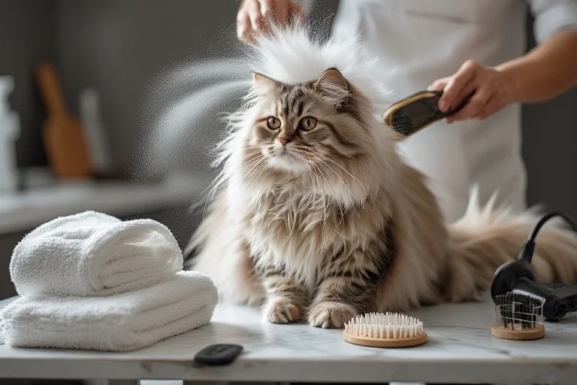
- Long-haired cats (e.g., Persian, Maine Coon, Ragdoll) need to be thoroughly washed 1–3 days before the show with special cat shampoos and conditioners.
- Dry the coat with a hair dryer (using cold or warm air) until it is completely dry and fluffy.
- On the day of the show, the coat is combed out and tangles and dust are removed.
- Short-haired breeds (e.g., British Shorthair, Bengal, Sphynx) require less care – a shiny coat shampoo and cleaning with a microfiber cloth are sufficient.
- Ears, eyes, and nails should be cleaned and trimmed before the show.
Preparation for behavior and socialization
- Start training early: your cat should be accustomed to the cage, carrier, hair dryer, and human hands.
- There are many smells and sounds at exhibitions, so it is advisable to train your cat in a crowded environment.
- Some breeders use pheromone diffusers (e.g., Feliway) to help calm cats before and during shows.
What to bring to the exhibition
- Vaccination passport and pedigree certificate.
- Clean display cage and cover (white or fabric matching the color of the breed is suitable).
- Combs, brushes, napkins, drinking bowl, and sandbox.
- A small amount of your cat’s favorite food and treats.
- A familiar blanket or pillow for your cat to feel safe.
Summary: The exhibition is more than a competition
A cat show isn’t just a competition for the title of the most beautiful cat—it’s an opportunity to learn, share experiences, and find inspiration.
Whether your goal is to win a title or simply to see how your cat performs in a professional setting—proper preparation and a positive attitude are the keys to success. Titles and awards provide owners and breeders with proof of a cat’s quality and help guide the development of the breed.